
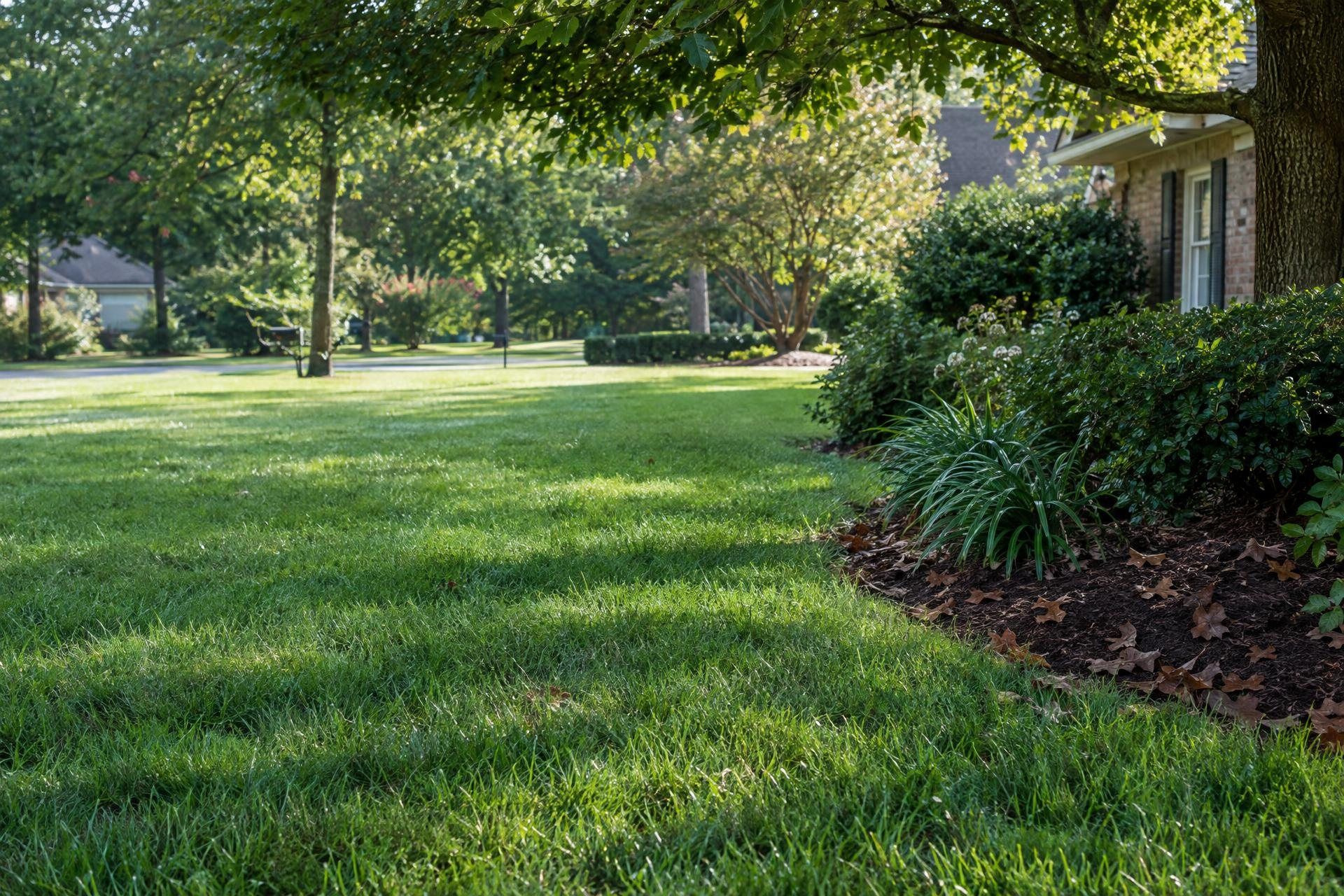
Lawn fertilization in Cullman and Morgan Counties, timed to when your grass is growing
Pale, slow, thin grass is usually hungry grass. Feeding puts back what mowing takes out, and getting the month right matters as much as what goes in the spreader.
- Free estimates
- Licensed and insured
- Twenty years in business
- Locally owned, out of Falkville
Why a mowed lawn needs feeding at all
Every time a lawn is cut, some of what the grass pulled out of the soil leaves with the blade tips. Nitrogen is the one that runs out first and the one grass needs most, because it drives the green growth and the thickness. Potassium and phosphorus matter too, for roots and for stress tolerance. A lawn that has been mowed for years and never fed has been running a slow deficit the whole time, and you see it as a yellowish cast, slow recovery after a dry spell, and grass that never quite closes over the bare ground.
Fertilizing is not a cosmetic treatment. Thick, well fed turf is the cheapest weed control there is, because weed seed needs bare soil and sunlight to get going and a dense canopy gives it neither. That is the whole reason feeding sits ahead of spraying in the order of work. A hungry lawn that gets sprayed every year is a lawn you will keep spraying.
The part people get wrong is the calendar. Warm season grasses, bermuda and zoysia, which is most of what grows on these lots, are dormant and brown through the cold months and do nothing with fertilizer put down then. They want feeding once they are actively growing in the warmth. Fescue, common on the shaded lots, runs on the opposite schedule and does its growing in the cooler parts of the year. Feed either one in the wrong window and you have paid to grow weeds.
How we set up feeding on your lawn
It starts with identifying the grass, because everything after that depends on it.
- 01
Walk the lawn
Free estimate first. Worth looking at: what grass you have, how thin it is, where the shade and the wet spots are, and whether the problem is really nutrition or something else.
- 02
Pick the season
Feeding belongs in the window when your grass type is actually growing. Warm season turf and fescue grow at opposite ends of the year, so the grass sets the month rather than the calendar.
- 03
Put it down evenly
Spread in measured passes so there are no dark green streaks and no skipped lanes. Even coverage is most of the result, and it is the thing a shoulder spreader rarely achieves.
- 04
Watch how it responds
Colour and density tell you whether the lawn was short on feed or short on something else. What we see on the next visit is what sets the one after it.
Signs your lawn is underfed
Hunger looks different from drought and different from disease. These point at feeding.
- The grass is a pale, yellowish green even in the weeks it has had plenty of rain.
- It grows so slowly that you have quietly stretched mowing out to every third week.
- Clover and other low broadleaf weeds have taken over the thinnest parts of the lawn.
- The strip along the driveway and the sidewalk is noticeably worse than the middle of the yard.
- Last summer’s dry spell browned it out and it never fully came back once the rain returned.
- A neighbour’s yard on the same soil is visibly thicker and darker than yours is.
Feeding fixes the grass that is there. It cannot create grass where there is none, so if the thin areas are actually bare soil under a tree or along a worn path, the fix is seed rather than fertilizer, and that is lawn overseeding. Plenty of yards need both, in that order, and sorting out which applies where is worth doing before anything goes in the spreader.
Why have us feed it
Black Diamond Outdoor Solutions is a family owned, locally owned crew working out of Falkville and covering surrounding areas, licensed and insured, with twenty years behind it. Feeding is one piece of the wider lawn care list we run, not an upsell tacked onto a mowing visit.
Feeding and lawn mowing are both on the list here, so the grass and what goes into it are not split between two companies. Estimates are free. The phone is answered Monday to Friday, 8 to 5.
Feeding lawns on Cullman and Morgan Counties clay
We cover Cullman, Falkville, Hartselle, Good Hope, West Point and Priceville from the Falkville base. The red clay under most of these yards holds nutrients reasonably well but compacts hard, and compacted ground limits what roots can reach no matter what you put on top. That is why we look at the ground and the grass together instead of just quoting a number of applications.
What customers ask about feeding a lawn
How many times a year does a lawn need it?
It depends on the grass and how hard you push it. A warm season lawn being fed to look its best takes more visits through the growing heat than a fescue lawn in the shade does. We would rather look at your yard and tell you a number that fits it than publish one that fits nothing.
Will fertilizer get rid of my weeds?
Not directly, but it works on the cause. Thick grass shades the soil, and weed seed needs light and bare ground to establish. Feeding a thin lawn until it closes up makes weed control a much smaller job. Weeds already growing out there still need treating on their own.
Do I need to water after it goes down?
Most granular products need moisture to move the nutrients into the soil where roots can take them up. Sometimes a rain does that job for us, and sometimes you need to run water on it. We will tell you which applies on the day rather than leaving you guessing.
Is it safe around my kids and the dog?
Every lawn product carries label instructions covering re entry, watering in and how long to stay off the grass, and the label is the authority on it rather than anybody’s opinion. Ask what went down on your yard and what its label says, and if you have a reason to need the lawn that day, raise it before the work is scheduled.
My lawn is brown right now. Should I feed it?
If it is brown because it is a warm season grass in its dormant months, no. Dormant grass does nothing with fertilizer and the only thing fed is the winter weeds growing through it. If it is brown in the middle of the growing season, something else is wrong and that is worth a look.
Tell us your town and which part of the lawn is going backwards. Estimates are free.