
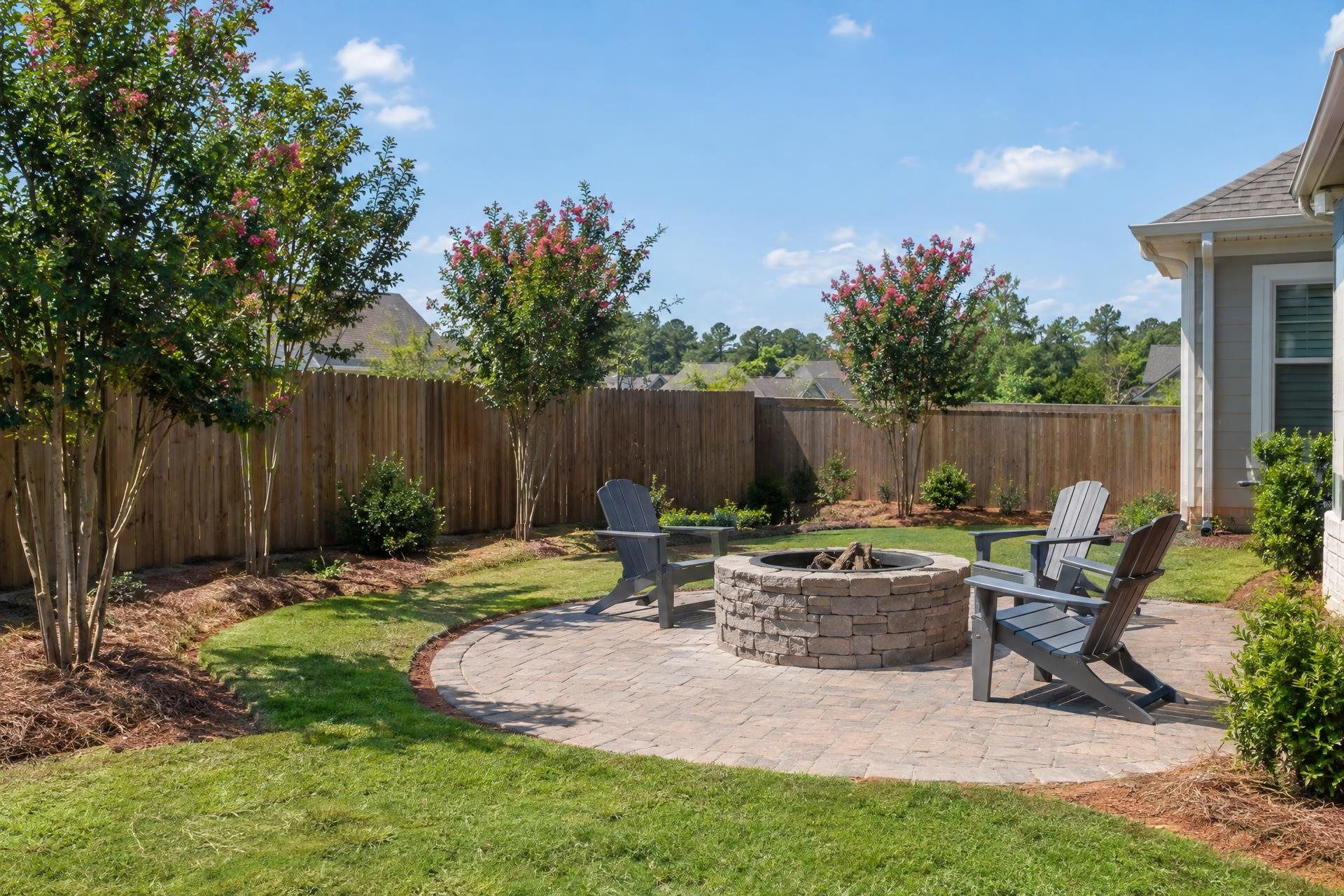
Hardscape installation in Cullman and Morgan Counties built on a base that holds
Stone, block and paver work quoted as one project: the excavation, the compacted base, the edges and the drainage that decide whether any of it is still flat in five years.
- Free estimates
- Licensed and insured
- Base built in layers
- Twenty years at it
The part of hardscape nobody sees
Hardscape is the hard part of the yard: the patio, the wall, the path, the steps, the pad, the ring around the fire. People choose it by the colour of the stone, and the stone is the last thing that matters. What decides whether a hardscape job is good is everything underneath and around it, and all of that is invisible the day it is finished.
Underneath, there is excavation down to firm ground, a crushed stone base put in and compacted in layers rather than dumped at full depth, and a screeded bedding course. At the sides there is edge restraint, because a paved surface with no restraint spreads outward under load until the joints open. And through all of it there is a plan for water: a deliberate fall away from the house and a route out from behind anything that holds back soil.
There is a good reason to think about hardscape as a body of work rather than one feature at a time. A patio, a short wall and a path on the same property share the excavation, the gravel, the compaction and the machine time. Grouped together it is one setup and one consistent base. Split across three separate jobs by three different people it is three bases of three different qualities, and the one that was built thin is the one you notice.
How hardscape goes in, layer by layer
The sequence is not negotiable, because each layer only works if the one under it was done right.
- 01
Lay out and dig
Shape is marked on the ground, then excavated to depth, allowing for the base and the thickness of the material. What happens to the spoil gets agreed in the quote.
- 02
Base in lifts
Crushed stone goes in and gets compacted in layers. Depth depends on what is going on top and whether anything will drive on it.
- 03
Set and cut
Bedding layer screeded flat, units laid to the pattern, then cut in at the edges and around anything fixed so the perimeter reads as deliberate.
- 04
Restrain and lock
Edge restraint goes in, joints are swept full, and the surface is compacted so everything beds together instead of moving independently.
Hardscape problems we get called out for
Some of these are a new project from scratch. Others are an existing surface that has moved.
- An existing patio has dipped in the middle and now holds a puddle after every rain.
- Pavers have spread at one edge and the joints have opened wide enough to see dirt.
- Water runs off the stone back toward the house instead of away from it.
- A slope behind the house takes up a third of the lot and cannot be used for anything.
- You want an outdoor space with a surface, a seat wall and a path and you want one price for it.
- The concrete slab that came with the house is cracked, stained and smaller than you need.
A surface that has sunk or spread is almost always a base failure, not a stone failure. That is worth knowing before you pay to have the same pavers relaid on the same thin gravel. What a failed surface really tells you about is what is underneath it, so free estimates are the cheap way to find that out.
Who builds your hardscape
Black Diamond Outdoor Solutions is family owned, locally owned, licensed and insured, based in Falkville, with twenty years of outdoor work behind it. Hardscape sits alongside land clearing, land grading, sod and track loader work on the same service list, and on a stone job that overlap counts. Excavation, moving spoil and bringing in base is machine work, and a base is only as good as the depth it was actually built to.
Because the planting side is on that list too, the edges work out. A surface that runs into a bed gets built knowing the bed is coming, which is why hardscape and landscape installation often go in on the same project. The single most common piece of it is a paver patio, and the wall, the steps and the path around one are built on the same base. Free estimates.
Hardscape work around Cullman and Morgan Counties and West Point
We build stone work in Cullman, Falkville, Hartselle, Good Hope, West Point, Vinemont and Priceville. The ground here is mostly red clay, which means two things for hardscape: water does not drain away through it, so the fall and the base have to do that job, and it compacts hard and holds well once a proper base is set on it. Tell us your town and what you want built, and we will come read the ground. The rest of what we install sits under landscaping.
What customers ask about hardscape before they commit
How deep does the base have to be?
It depends on what is going on top and what the soil under it is like. A walkway carrying feet is one thing, a pad that a vehicle will sit on is another. What does not change is that the stone is compacted in layers and brought up to a firm, flat surface before anything is laid. That gets settled when we look at the site.
Pavers or poured concrete?
Pavers move with the ground in small amounts and can be lifted and reset in one area without touching the rest. Concrete is one piece, so when it cracks the repair shows. We build in pavers, block and stone. If concrete is genuinely the better answer for what you want, we will say so instead of selling you something else.
Can you tie new stone into what is already there?
Usually yes, and it is worth looking at closely first. Matching older material exactly is often impossible, so the better approach is a deliberate change of material or a border that makes the junction look intended. The thing to check before you tie anything on is whether the old surface is still sitting still, because new work butted against a sinking one gets pulled down with it.
Will weeds come up through the joints?
Seed blows onto the surface and germinates in the joint sand, so what grows there starts from the top rather than from below. Joints swept properly full and kept topped up give that much less to root in. It is maintenance either way, not a defect in the build.
Does the weather decide when this can be built?
More than the calendar does. Stone does not care about the season, but wet clay cannot be compacted properly, so a run of heavy rain is what moves a start date rather than the month on the wall. Our office hours are Monday to Friday, 8am to 5pm, and the honest answer about timing is the one you will get when we quote it.
Tell us your town and what you want built. Free estimates.