
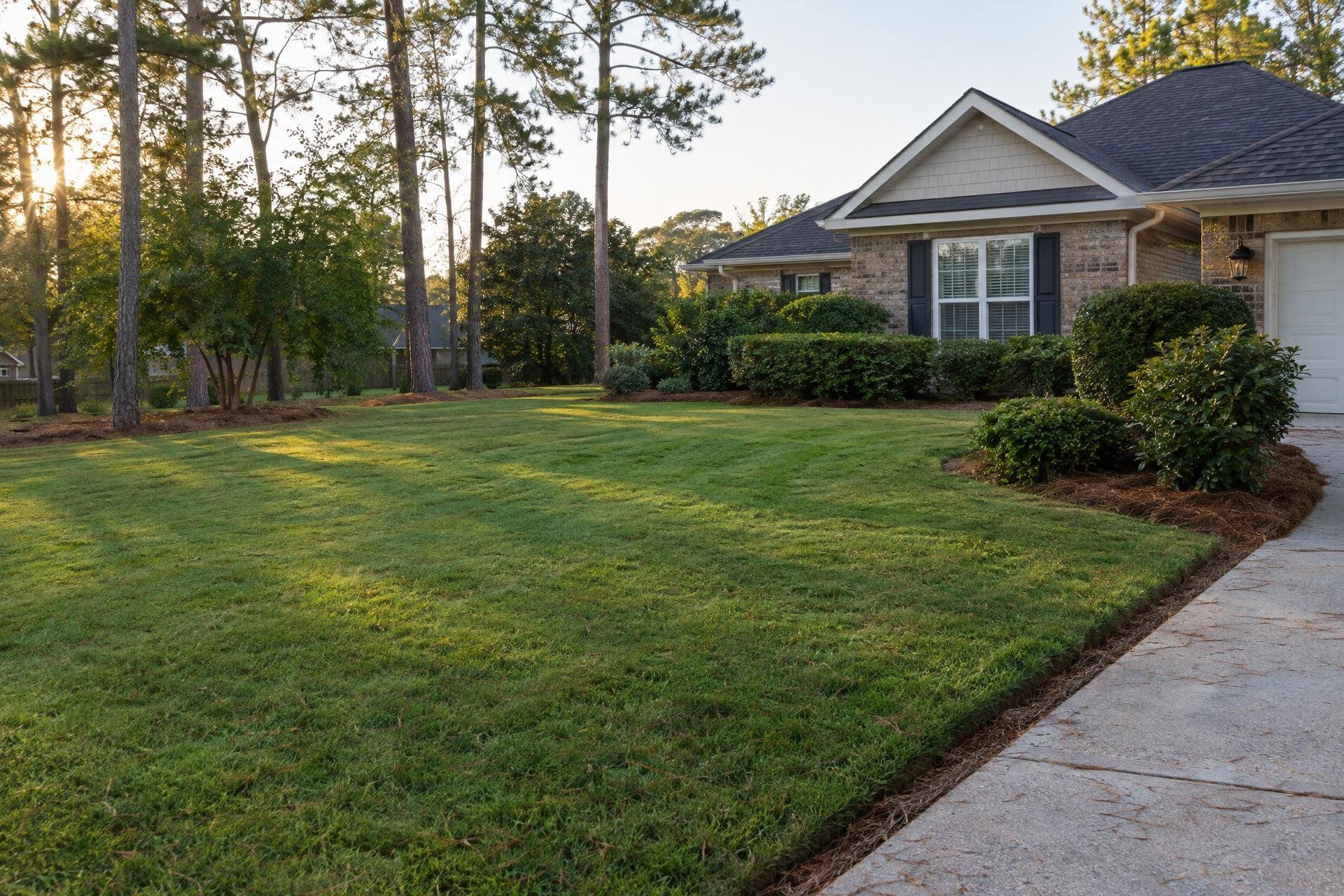
Hedge trimming in Cullman and Morgan Counties, cut back off the house and the walk
Shrubs and hedges brought back to a line, pulled off the siding, the windows and the walkway, and the dead wood taken out of the face of the plant.
- Free estimates
- Licensed and insured
- Same-day service available
- Family owned, out of Falkville
What hedge trimming does for the front of a house
Foundation shrubs grow out, not just up, and they do it slowly enough that nobody notices until the holly is against the brick and the window behind it is dark at two in the afternoon. Trimming is the work of putting that back: a face and a top cut to a line, the sides brought in off the siding and the walk, and the inside of the plant opened enough that light reaches it.
The reason a shrub needs the sides taken in is not only how it looks. Growth packed hard against a wall holds moisture against the siding and gives insects a covered road up to it. Branches across a walkway catch on people carrying things. Growth over a drive blocks the view of the road where you pull out. And any shrub only sheds light at the outside, so a hedge left alone for a few years goes dense on the skin and bare and twiggy underneath, which is the point at which cutting it back stops being tidying and starts being renovation.
A hedge wants its top narrower than its base. Cut square-sided or wider at the top, the upper growth shades the lower growth, and the bottom thins out and never comes back properly. That taper is the difference between a hedge that holds a shape for years and one that has to be fought with every season. It also means how much comes off, and when, depends on the plant. A boxwood, a holly, a crepe myrtle and an overgrown privet do not get treated the same way.
How a hedge gets brought back to a line
Three steps, and the first one is a conversation about the plants rather than the tools.
- 01
Walk the beds with us
Tell us what you want held and what you want pulled back hard. A hedge screening a road is a different cut from foundation shrubs under a window.
- 02
Cut to a line
Faces and tops are cut to a line with the base left wider than the top, sides taken in off the siding, the walk and the drive, and the dead wood pulled out.
- 03
Trimmings dealt with
A pile of cuttings left down in a bed smothers what is planted there, so where the trimmings end up is worth settling before anybody starts cutting.
When shrubs have gone past tidy
Any of these and the plants are overdue rather than merely untidy.
- Growth is touching the siding, the brick or the trim of the house.
- A window is half covered and the room behind it has gone dark.
- You turn sideways to get past a shrub on the front walk.
- Growth over the drive blocks your view of the road pulling out.
- The hedge is dense on the outside and bare and twiggy down inside it.
- The top has grown wider than the bottom and the base has thinned out.
- Dead wood is showing through the face of the plant from last winter.
Shrubs that have been cut back hard leave bare soil and a changed bed line showing underneath them. If that is where your beds are headed, it is worth sorting the edges and the ground cover in the same run as a spring cleanup rather than coming back to a tidy hedge standing over an untidy bed.
Who cuts your hedges
Black Diamond Outdoor Solutions is a family owned, locally owned crew out of Falkville and covering surrounding areas, licensed and insured, 20 years in business. Hedge trimming is one of the lawn services on our own list, so the shrubs do not have to be somebody else’s separate appointment.
Estimates are free, so having somebody look at the beds and say what the plants actually need is a straightforward call to make. The rest of the lawn care comes from the same place, and if you want the lawn mowing looked at while we are standing in the yard, say so and it goes in the same quote. Same-day service when the day has room in it.
Hedges we cut around Cullman and Morgan Counties and Priceville
We cover Cullman, Falkville, Hartselle, Good Hope, West Point, Vinemont and Priceville from Falkville. Long warm summers here push shrubs hard, so foundation plantings that looked right in April can be on the brick by August, and the heat is also why we would rather not take a huge amount off a stressed plant in the worst of it. Growth that strong is being fed by something, and on properties where the beds are mulched and the turf is on lawn fertilization it shows in the shrubs first.
What people ask about trimming shrubs
How often do hedges need cutting?
More than once a year on most properties here, because the growing season is long. Fast growers like privet and ligustrum push hard and want going back to a couple of times. Slower, denser plants such as boxwood hold a shape far longer. What yours need depends on the plant and how sharp a line you want kept.
Can you cut an overgrown hedge right back?
Sometimes, and it depends on what it is. Some shrubs break back willingly from old wood and recover well. Others go bare and stay bare, and with those it is better taken back over more than one season. We will tell you which of those your hedge is before anything is cut, not after.
Is there a wrong time of year for it?
Timing matters most with flowering shrubs, because cutting at the wrong point takes off the buds and costs you a season of bloom. Heavy cutting in the hottest stretch is also hard on a plant. Routine shaping is far more forgiving. Say what is in the bed and we will work around it.
How much material comes off a hedge?
More than a run of foundation shrubs looks like it would hold, especially on a plant that has not been cut in a couple of seasons. Cuttings left lying in a bed smother whatever is planted under the shrub, so the pile is worth thinking about in advance. Say what you would like done with it when you call.
Will you work around my flower beds?
Yes, and it helps to point out anything you care about before we start. Perennials coming up under a shrub are easy to miss and easy to stand on. Walk us round and tell us what is planted where, and it stays out of the way of the work.
Tell us your town and roughly how many shrubs there are. Estimates are free.