
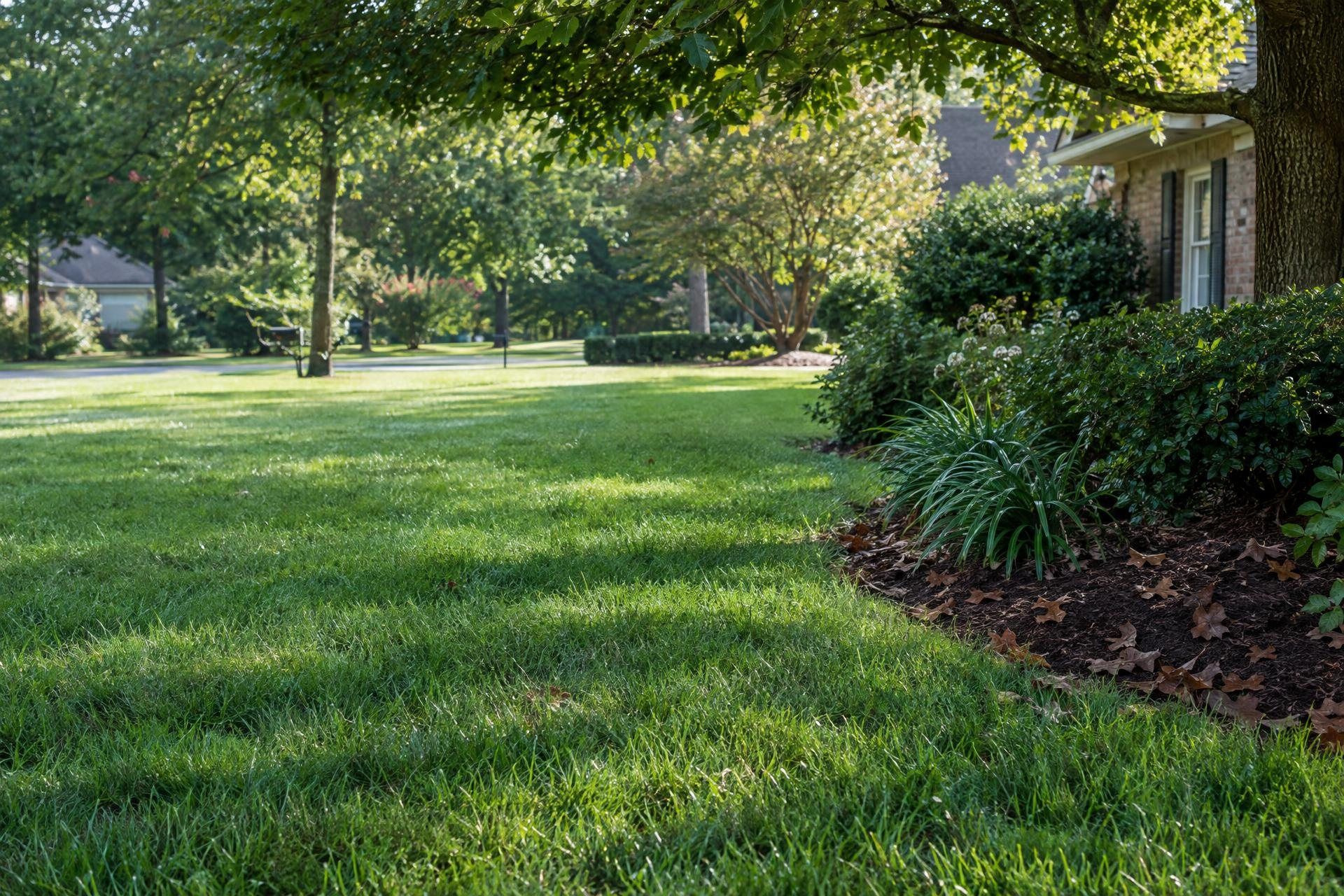
Lawn care in Cullman and Morgan Counties for the yard that got away from you
Nine jobs sit under lawn care here, from the weekly cut to the stuff that only matters twice a year. Tell us which part of your yard is the problem and we will sort out the rest.
- Free estimates
- Same-day service available
- Licensed and insured
- Twenty years at it
What lawn care covers on a lot around here
Lawn care is two different kinds of work wearing the same name. One half is the cut: a mower on the grass on a schedule, edges done, clippings dealt with, hedges kept off the walkway. The other half is what goes into the ground and what comes off it, which is feeding, seed, weed and insect work, and the heavy clearing of debris at either end of the growing season.
Most people call about the first half and find out they needed the second. A lawn that has been mowed faithfully for three years and never fed goes thin and pale, and thin grass is where crabgrass moves in. Grass that is fed but never overseeded keeps the same bare patches it had in April. The jobs lean on each other, which is why they are grouped here rather than sold one at a time.
The ground we work in is north Alabama red clay. It packs down hard, it sheds water in a heavy storm and holds it in a low spot, and it runs hot and dry from July into September. Most yards around here are warm season grass, bermuda or zoysia, with fescue on the shaded lots. Which of those you have decides most of what the lawn needs, so it is the first thing worth establishing about any yard.
The nine lawn jobs we get called out for
Pick the one that matches what you are looking at in the yard.
- 01
Lawn mowing
On a scheduleThe regular cut, run on whatever interval the grass actually needs rather than one fixed schedule for every yard. Edges along the drive and the walks get cut in, and the height is set by the type of grass you are growing, not by one setting used on every lawn. If the yard has gotten tall enough that it needs knocking down before a routine makes sense, say so and that is where we start. Full detail on lawn mowing is worth a read first.
- 02
Lawn fertilization
Feeding the grassGrass is a crop, and a crop pulls out of the soil every time you cut it and haul the clippings away. Fertilizing puts nitrogen and the rest back, which is what turns a pale, slow lawn into one that fills in on its own. Timing is most of the skill: warm season grass gets fed when it is growing hard in the heat, and feeding it in the wrong month does nothing or feeds the weeds instead. What a lawn fertilization program looks like on your yard starts with what grass you have.
- 03
Lawn overseeding
Filling in thin grassFeeding helps grass that is already there. Where there is no grass left, under a tree, along a worn path, in the strip the dog runs, you have to put seed down. Overseeding spreads new seed into the existing lawn so it thickens from the inside out, and the part people skip is the contact between seed and soil, because seed sitting on packed clay just feeds the birds. The season has to be right too. Read how lawn overseeding is done so the seed actually comes up.
- 04
Weed control
Clover, crabgrass, nutsedgeEverything green in the yard that is not the grass you planted. Broadleaf weeds like clover and dandelion take one kind of treatment, grassy weeds like crabgrass take another, and nutsedge is its own fight, which is why one jug from the shelf rarely clears a yard. Part of the job is stopping next year’s crop before it sprouts rather than spraying what already has. Our weed control work starts with naming what is growing out there.
- 05
Grub control
Damage under the sodWhen patches of lawn go brown in late summer and the dead sod lifts like carpet with no roots holding it, the problem is usually under the grass and not on it. Grubs are beetle larvae that eat roots, and the second sign is the skunks and armadillos tearing up the yard to get at them. Treatment is about catching the right stage of the insect, not just soaking the spot. See what grub control involves if that sounds like your yard.
- 06
Spring cleanup
Getting the year startedWhat winter left behind, cleared off in one visit so the growing season can start clean. Limbs down from the ice and the wind, matted leaves in the beds, dead growth on the perennials, gravel thrown into the grass off the drive. It matters more than it sounds, because anything lying on the lawn in March is a dead patch in May and a weed patch in June. The run through of a spring cleanup lists what gets touched.
- 07
Fall cleanup
Closing the yard downThe other end of the year, and a different list of work. Beds cut back, annuals pulled, the last cut taken at the right height, debris off the lawn before it sits under wet weather for four months. Done properly it is the difference between a lawn that wakes up in spring and one that comes back in rough shape with bare ground showing. Here is how a fall cleanup is put together on a typical lot around here.
- 08
Leaf removal
Hardwood lotsIf you have oaks or hickories on the lot, this is its own job and not part of mowing. Leaves pile deep, they mat down after the first hard rain, and grass under a wet mat for a few weeks suffocates. There is also a lot of volume to move, which is the real reason people give up on raking halfway. What leaf removal looks like depends on how many trees you have and where the leaves can go.
- 09
Hedge trimming
Shrubs and linesShrubs along the foundation, a privet line on the property edge, hollies at the corners of the house. Trimming keeps them off the siding and the windows and keeps the shape from going wild, and where you cut matters, because shearing the outside of some shrubs every time leaves them hollow in the middle. When hedge trimming happens in the year depends on whether the shrub flowers and when it sets its buds.
The crew that shows up to your lawn
Black Diamond Outdoor Solutions is family owned and locally owned, run out of Falkville and covering surrounding areas, licensed and insured, and twenty years into this work. Lawn care is the first of the five services we advertise, which means it is the bread and butter here and not something squeezed in between bigger jobs.
Lawn care, soft pressure washing, land clearing and sod and dirt work are all on the list here, so the grass and the brush line behind it do not take two separate companies. Estimates are free, and when the schedule has room we can get out the same day. Monday to Friday, 8 to 5, is when the phone is answered.
Where we cut grass around Cullman and Morgan Counties
The base is Falkville and the route runs through Cullman, Hartselle, Good Hope, West Point and Priceville. Lot sizes here go from a half acre in town to several acres out on the county roads, and that difference decides the equipment more than anything else does. Give us your town and the rough size of the yard and we will come look at it.
What people ask before starting lawn care with us
Do I have to sign up for all of it?
No. Plenty of customers only want the grass cut and handle the rest themselves. Others want the cut plus feeding and weed work and nothing else. Tell us what you want us on and that is what you get a price for, and anything you did not ask about is worth asking about by name rather than assuming either way.
Can you just come once and get it back under control?
Yes. A one time cleanup cut on a yard that has gotten tall is a normal thing to ask for, and some people stop there while others carry on afterwards once they see it looking right. Bringing tall grass down is slower work than keeping a tidy lawn tidy, so it is worth describing how far it has gotten when you call and asking about that first cut on its own.
What grass do I have?
Most yards around here are bermuda or zoysia, both warm season grasses that go brown in winter and green up in late spring. Shaded lots are often fescue, which stays green through the cold and struggles in August heat. The quick tell is winter colour: grass that browns off entirely is warm season, grass that holds green through January is not.
Does it cost anything to get a price?
No. Estimates are free. Nine separate jobs sit under lawn care, so the useful thing to do is name the ones you are weighing up and ask what each of them would involve on your particular lawn, because the answer on a shaded half acre is not the answer on two open acres of bermuda.
Which of these jobs should happen first?
Usually the one dealing with the cause rather than the symptom. Feeding a thin lawn before spraying it, clearing debris off the grass before seed goes anywhere, and sorting out an insect problem before putting new grass into the same ground. We will walk the yard and tell you the order we would take it in, and you can take as much or as little of it as you want.
Tell us your town and what the yard looks like right now. Estimates are free.