
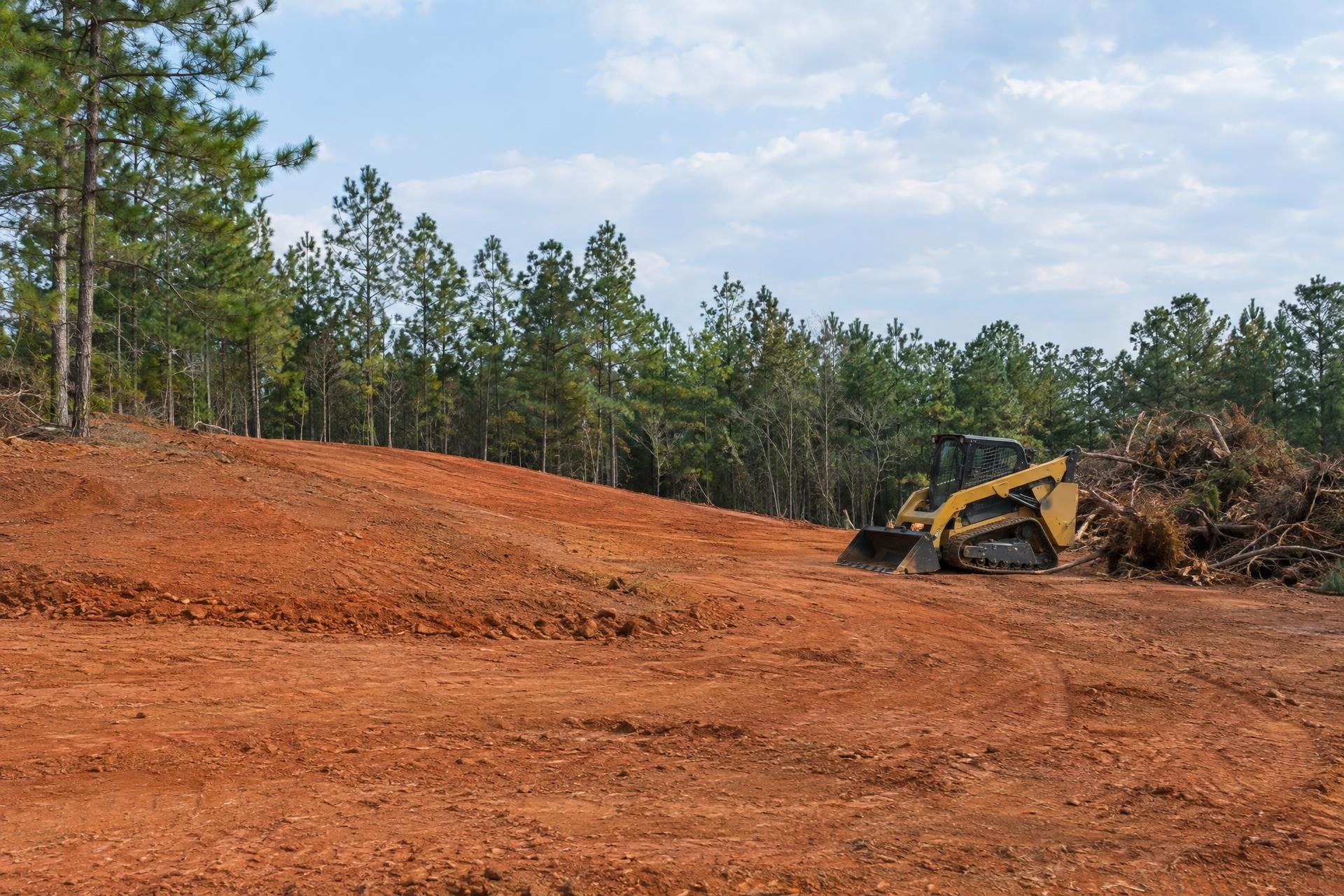
Demolition in Cullman and Morgan Counties, for the building that is already done
The shed nobody uses, the pad that cracked apart, the deck that is going soft. Taking it apart is one question and what happens to the pile is the other, and both get priced before anybody starts.
- Free estimates
- Licensed and insured
- Twenty years in business
- Family owned, out of Falkville
Demolition on a residential property, start to empty ground
Residential demolition is not the wrecking ball people picture. It is a machine, a few hand tools and a trailer, taking a structure apart in the order it was built, lowest value first. A pole barn comes down in sections. Concrete gets broken up and loaded as rubble. A deck gets stripped of boards before the frame and posts come out of the ground. The aim is ground you can walk across with nothing left to trip over.
The honest part most quotes skip: the tearing down is the fast half. Dealing with the material is the expensive half. An eight by twelve shed is a short job and several trailer loads of lumber, roofing and whatever was stored inside it. Concrete is worse, because broken slab is heavy and nobody takes mixed rubble for free. So the first thing to settle on any tear-out is where the pile ends up, and that is a question to get a straight answer to before the work starts.
What is in the thing matters too. Old barns hold loose tin, rotten purlins and wasps. Sheds hold paint, fuel cans and fertiliser that have been sitting for a decade. Buried footings and anchor bolts turn up under old carports and they are exactly what a mower finds later. All of that gets looked at before a price is given, which is why nobody can quote a tear-out over the phone.
How a tear-out gets quoted and scheduled
Four steps, and two of them are about the pile rather than the building.
- 01
Look at what is coming down
We walk it, look at how it was built, what is stored inside, what is attached to it and what is close enough to damage. The estimate is free.
- 02
Decide what stays
Some of it is worth keeping. Good tin, usable lumber, a slab that could stay as a pad. Tell us before anything starts, because it is hard to un-break a thing you wanted.
- 03
Settle where the debris goes
Whether it leaves the property, gets stacked in a corner, or goes on a burn pile is a decision with a cost attached. Settle it at the estimate, so nobody is working it out standing next to a pile of tin.
- 04
Agree the finished ground
Footings, anchor bolts and post stubs are a separate question from the structure above them. Say whether you want them out and the ground raked over, and it is part of the price instead of an extra.
When the old structure stops being worth keeping
Any one of these usually means tearing it out is cheaper than another round of patching.
- A shed or barn roof has gone through and the frame has been wet for years.
- Loose tin lifts in a storm and the next strong wind is going to take it somewhere.
- A concrete pad has broken into pieces that rock when you step across them.
- Deck boards flex underfoot and the posts are soft where they go into the ground.
- A fence run has more leaning posts than straight ones and nobody is repairing it again.
- You need the footprint for something else, like parking, a shop or a garden.
- An insurance renewal or a sale is coming and the derelict building is the problem on the list.
Once a structure is gone you are looking at a bare rectangle, often with a hump of old fill or a dip where a slab used to be. Bringing it back level is land grading, and it is far easier to quote alongside the tear-out than after the grass has grown back over the lumps.
Who to call about a demolition job in the county
Black Diamond Outdoor Solutions is licensed and insured, family owned and locally owned, based in Falkville and twenty years into outdoor work. Land clearing and demolition is one of the five jobs we advertise ourselves. Insurance is not a detail on this one: a tear-out is the job most likely to put something heavy near a fence, a vehicle or a neighbour’s line.
Demolition sits in the same excavating trade as the dirt work, which keeps a tear-out from turning into three separate bookings. Lifting and stacking what comes off a structure is the same bobcat work priced on its own page, so both halves can be looked at in one visit. Estimates are free, and the phone is answered Monday to Friday, 8am to 5pm.
Tear-outs around Cullman and Morgan Counties and Good Hope
We take demolition calls in Cullman, Good Hope, Falkville, Hartselle, West Point, Vinemont and Priceville. A fair number of lots out this way came with a barn, a chicken house or an equipment shed from a previous owner, and at some point the thing stops being storage and starts being a liability. Give us the town and tell us roughly how big it is, and we will come look at it.
Questions before a demolition job gets booked
What happens to all the debris?
It is the first thing to settle and it drives the price more than the building does. Hauling it off, stacking it on site and burning what can legally be burned are three different jobs with three different numbers. Tell us what you want at the estimate and you get the number for that version of the job, not a surprise later.
Do I need a permit to tear down a shed or a barn?
It depends on the structure and on the rules where you live, inside a city limit or out in the county, so the only reliable answer is from your own building office. We will tell you what we see at the estimate, but checking the local rule for your address is on the owner, not on us.
Can you look at concrete as well as buildings?
Yes. Cracked pads, old sidewalk runs, a slab under a carport that is coming down anyway. Concrete gets handled differently from timber because of the weight, and that weight is what decides the cost of moving it, so mention the rough size of the slab when you call.
What about the footings and posts in the ground?
They are a separate line of work from the structure standing on them, and they are the thing people forget until a mower or a bare foot finds one. Decide at the estimate whether you want them pulled and the ground raked, so it is quoted rather than discovered.
What about the house and fences right next to it?
That is what the walk-through is for. We look at how close the house, fences, trees and power are, and what that means for the job, which sometimes means a structure has to come apart in pieces rather than come down in one go. Move vehicles and anything you care about off the area before the day.
Tell us your town and what is coming down. Ask for a free estimate.